
A comparative essay is a type of essay in which an essay writer compares at least two or more items. The author compares two subjects with the same relation in terms of similarities and differences depending on the assignment. The main purpose of the comparative essay is to: Highlight the similarities and differences in a systematic manner Writing a great comparative essay means highlighting the similarities and differences between two things in a systematic manner. Start by choosing the parameters (items) to compare, write an outline, and fill in the details for each section. Make sure to have an introduction and blogger.comted Reading Time: 9 mins The Comparative Essay What is a comparative essay? A comparative essay asks that you compare at least two (possibly more) items. These items will differ depending on the assignment. You might be asked to compare • positions on an issue (e.g., responses to midwifery in Canada and the United States) • theories (e.g., capitalism and communism)
Comparative Essay – Structure, Topics, & Exampless
Writing a great comparative essay means highlighting the similarities and differences between two things in a systematic manner. Start by choosing the parameters items to compare, write an outline, and fill in the details for each section. Make sure to have an introduction and conclusion. The comparative essay is one form of document that you will probably be expected to write at some point over the course of your college career.
The purpose of this article is to provide you with a thorough overview of the comparative essay. Specific things that will be addressed include:. By the end of this article, you should feel more confident about your own knowledge of what a comparative essay is and the best ways to go about writing one if you haven't decided to buy writing a comparative essay comparative essay from Ultius. The fundamental purpose of a comparative essay is to elaborate the similarities and differences between two things in a systematic manner.
An effective comparative essay will leave the reader with much greater clarity about the natures and properties of the things that have been compared. This could potentially serve as a basis for making a decision in favor of one or the other thing.
A comparative essay is different from, writing a comparative essay, for example, an argumentative essay in that the comparative essay does not make a case for either of the two things under comparison.
Rather, the point is to simply set up the comparison so that the reader will have as much information about the two things as possible, writing a comparative essay.
The comparative essay is an important form of document because when you have to make a decision or choose a side in an argument, writing a comparative essay, you will want to know as much as possible about the two options under consideration—and a good comparative essay on the subject can bring out both the similarities and the differences between the options, thereby clarifying the stakes at play. For example, a comparative essay could address the similarities and differences between any of the following pairs:.
By developing a comparative essay on any of these pairs, you can not only understand each item of under comparison is a more thorough way, you can also get closer to figuring out which item you prefer. For example, a solid comparative essay on revolution vs. reformism could not only help you understand what each of these items entails, writing a comparative essay, it can also help writing a comparative essay figure out whether you would rather be a revolutionary or a reformist.
Likewise, if you only have time to binge watch one show, then a comparative essay could help you figure out whether you would prefer to go with Game of Thrones or Westworld, writing a comparative essay. When writing a comparative essay, there are several models you can use in order to ensure that you set up your comparison as effectively as possible. The Venn diagram is a classic, and surely, you're familiar with it. This is the model of two overlapping circles, where each circle belongs to one item of comparison: features shared by both items similarities go in the overlapping middle zone, whereas features that are not shared go in the outer areas.
For example, here is a Venn diagram that compares humans against gorillas. When using the Venn diagram model, it is important to note that the differences must be symmetrical. In other words, every difference you list on one side of the comparison must be matched by a difference on the other side.
For example, if you were comparing Apple and Amazon, then for the parameter of "founder," you can list "Steve Jobs" in one circle and "Jeff Bezos" in the other. But it wouldn't make sense if you just listed one or the other: you must list something for each of the items of comparisons under the selected parameter of comparison. In the Venn diagram above, the first parameter is "language," so for humans it is listed that we have a capacity of language, whereas for gorillas it is listed that they do not.
You don't need to worry about this kind of symmetry when it comes to the similarities, since you will list the same thing for both items of comparison which means you only have to list it once, in the overlapping zone. In the example, above, the fact that both humans and gorillas are mammals is thus listed just once in the middle. The dialectical method is important within the discipline of philosophy, and it has been used to great writing a comparative essay by thinkers such as Socrates and Hegel and Kierkegaard.
This involves holding two ideas or items in tension with each other, to better clarify not only the ideas themselves but also the dynamic relationship that exist between the ideas. The first idea is called the thesisand the second idea is called the antithesis. For example, Romanticism could be dialectically compared against the Enlightenment that came before it, because Romanticism was in some ways a rejection of the previous worldview.
Need help? Essay writing services from Ultius can help you produce a great sample compare and contrast essay. So, by setting up a comparison between Romanticism and the Enlightenment, it becomes possible to see both the continuities or similarities between the one and the other, as well as the contradictions or differences between them.
Berlin, Isaiah. The Roots of Romanticism. Princeton: Princeton U P, From the table above, it is clear that we are able to understand both Romanticism and the Enlightenment better if we set them up in terms of dialectical contrast.
Clearly, they are different in some important ways logic vs. passion, for examplebut we can also see that they are in continuity with each other both happened in Western Europe and responded to previous developments. This comparison also leads one to wonder about whether it would be possible to make a synthesis that takes the best from both the thesis and the antithesis. To analyze your subjects for a comparative essay, you need to identify clear parameters, or axes, in terms of which your two selected items can be compared.
For example, in the table above, Romanticism and the Enlightenment were writing a comparative essay along the axis of " epistemology ". But that axis won't be relevant to all subjects. Your job when preparing to write a comparative essay is to identify the specific axes that are relevant for the items that you are comparing. Why is the comparison interesting, and what insights are you trying produce?
The answers to those questions will determine how you decide to frame your comparison. For example, we could compare the Democratic Socialists of America DSA against the Democratic Party in terms of the axis of membership.
This would reveal that the DSA has far fewer registered members than does the Democratic Party. We could also compare them on the axis of healthcare policy, where it may be found that the DSA and the Democratic Party agree about the importance of universal coverage. When we look at the axis of economics, though, writing a comparative essay, we may find that the DSA is much more radical in its proposals than the Democratic Party.
In principle, any one thing in the world could be compared with any other thing in the world. For example, you could compare your shoe with the moon, and conclude that one similarity is that they both exist within the Milky Way galaxy. But this would be a meaningless point even if it may make for some interesting poetry. It is important for you to figure out what exactly you are trying to determine through your comparative essay.
What is your purpose for writing it? This will help you choose two items where setting up a dialectical contrast between them will produce actual insight, and it will also help you to choose the proper parameters by which to compare those items, writing a comparative essay.
For example, suppose that you are running a business, and there are two expansion options open in front of you. It would be logical for you to compare and contrast these options, since this will help ensure that you are making your decision with as much knowledge and insight as possible.
Likewise, one parameter that you are sure to consider is: which option will make your business the most money? If you pick parameters that are meaningless, then you will obtain no real insight that can help you make the important decision.
Once you have identified both the two items of comparison and the axes along which they will be compared, you can proceed writing a comparative essay analyze the items by applying the axes in the form of a table or rubric, writing a comparative essay.
This is what has been done, for example, in the tables that have been developed above in this article, writing a comparative essay. In the left-most column, list the parameters you have selected in order to compare your items. Then, in the top-most row, list the items. Then go ahead and list the relevant details for each parameter for each of the two items. This will produce a table where you can see how each item measures up against the other for each parameter.
The important thing is to be systematic writing a comparative essay you are making your comparison: it should not seem random writing a comparative essay arbitrary. A strong comparative essay has well-chosen items for comparison, with the comparison producing actual insights of value through the juxtaposition of the two items. If the items appear to be chosen for no apparent reason, or if the comparison does not in fact produce insight, then the comparative essay would be quite weak or at any rate pointless.
The comparative essay is not meant to make an argument in favor of one thing or another, but it is meant to writing a comparative essay knowledge and insight about the two things under comparison. In order to compare and contrast items in an effective way, the two items must be different enough from each other, but they should also not be so different that it just feels absurd to even compare them at all. A good comparative essay not only includes well-selected items of comparison, it also includes well-selected parameters of comparison.
Between any two selected items, writing a comparative essay, you could theoretically make an endless number of comparisons. But a good comparative essay identifies parameters of comparative in terms of saliencewriting a comparative essay, or the reasons why anyone would be interested in the comparison in writing a comparative essay first place.
This can be difficult, because in principle, writing a comparative essay, any comparison could be interesting, depending on the audience of the comparative essay and the intended purpose of the essay. For example, one could use the parameter of zodiac sign to compare Romantic artists against Enlightenment artists. This could be very interesting to people who are very serious writing a comparative essay the zodiac, but it would probably seem ridiculous to just about everyone else.
But if you were writing for an audience of zodiac fanatics, then this comparison could actually be a success.
So, there is no parameter of comparison writing a comparative essay is "inherently" bad. Rather, the point is to find parameters that highlight specific salient aspects of the selected items. For example, when comparing Romanticism against the Enlightenment, core values would be a solid parameter of comparison, because that will surely help produce insights about how worldviews changed from the one paradigm to another. If you want your comparative essay to be a success, then it absolutely must have strong organizational structure.
This is because an effective comparison must be easy for your reader to follow. It can't just jump all over the place at random, which not only be confusing but could also result in the reader forgetting what the point of the comparison was in the first place. In general, there are two ways in which you can organize your comparative essay, writing a comparative essay. In the first format, each of the parameters would be considered in the section for similarities and the section for differences.
In the first format the comparative essay is organized in terms of similarities and differences, whereas in the second format the essay is organized in terms of parameters of comparison. In the second format, writing a comparative essay, both similarities and differences would be considered within each of the parameter sections.
Both these are formats are good, and a strong comparative essay could be built around either one. There are steps you can follow in order to ensure that your comparative essay has all the elements that will be required in order to make it great.
If you have selected two items for your comparative essay, then you should start by asking yourself why you selected those two items. What is it about the two items that made you think it would be a good idea to compare them?
Or if you were assigned the two items, then why do you think those items were selected by your professor? The point here is that the items selected for a comparative essay are non-random.
They are selected because that specific comparison should be able to yield interesting insights unlike research papers. For example, if you are writing a comparative essay on the dogs vs.
How to Write a Comparative Essay - 3 Easy Steps
, time: 1:24Comparative Essay Writing - Format, Outline & Example
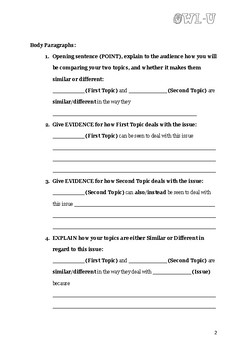
The Comparative Essay What is a comparative essay? A comparative essay asks that you compare at least two (possibly more) items. These items will differ depending on the assignment. You might be asked to compare • positions on an issue (e.g., responses to midwifery in Canada and the United States) • theories (e.g., capitalism and communism) A comparative essay is a type of essay in which an essay writer compares at least two or more items. The author compares two subjects with the same relation in terms of similarities and differences depending on the assignment. The main purpose of the comparative essay is to: Highlight the similarities and differences in a systematic manner Writing a great comparative essay means highlighting the similarities and differences between two things in a systematic manner. Start by choosing the parameters (items) to compare, write an outline, and fill in the details for each section. Make sure to have an introduction and blogger.comted Reading Time: 9 mins


No comments:
Post a Comment